Oven Repair
Why a Lexington Wolf Oven Keeps the Door Shut After Self-Clean
A code shown after a self-clean lockout names what the control observed, not the part that failed. Wait out the cool-down, check whether the display is alive at all, write the code down before clearing it, and note whether it returns the moment power comes back.
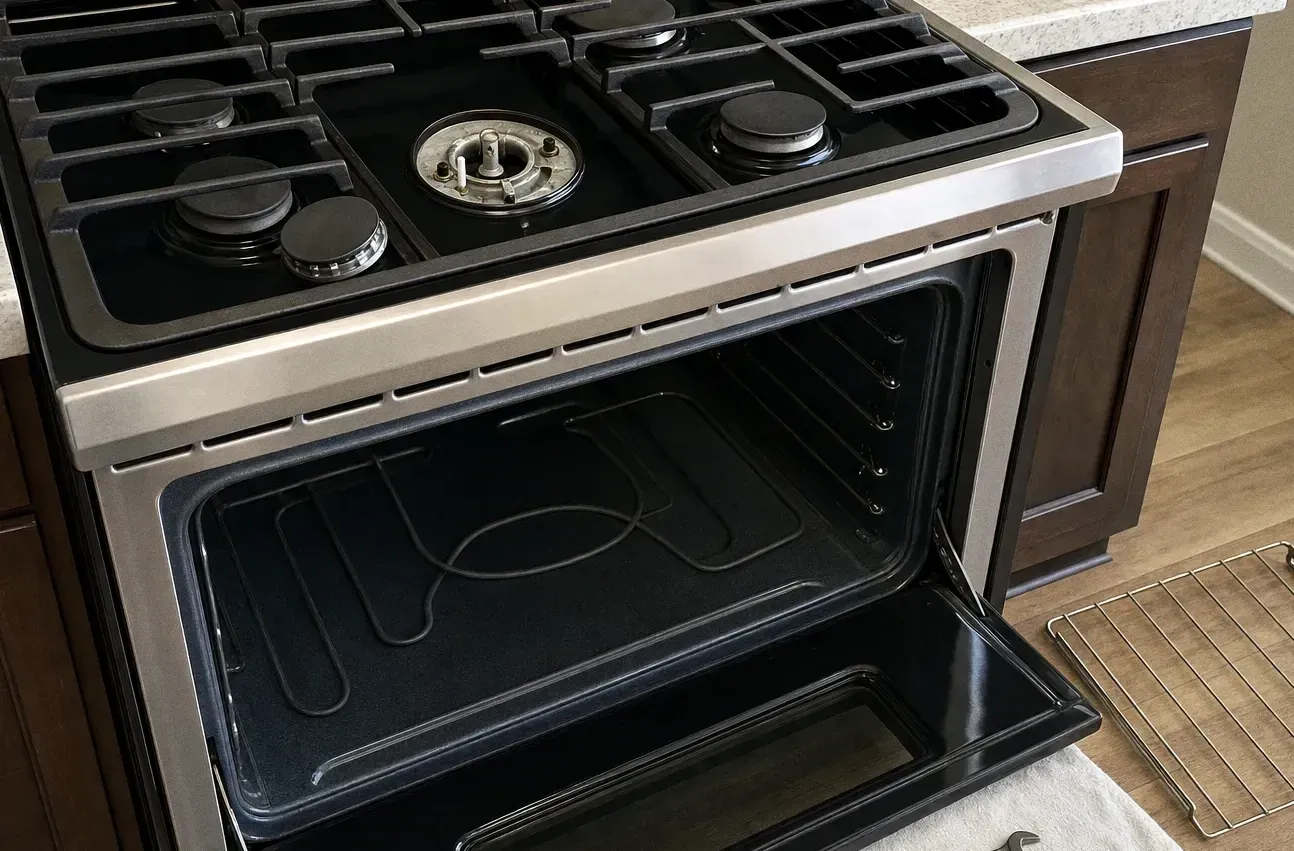
Somewhere between the end of the cycle and the following morning the display stopped showing the time and started showing a code, and the Wolf door has not moved since. The code feels like an answer. It is better understood as a witness statement: it says what the control noticed, in the control’s own terms, and stops well short of naming who is responsible.
Before you call it a fault, wait properly
A locked door immediately after a clean run is not evidence of anything. The control holds the lock until it reads the cavity below the temperature at which opening is permitted, and it goes on checking long after the heat has been switched off. Release therefore trails the end of the burn by a wide margin, and impatience accounts for a fair share of the calls we take on this.
From the kitchen it looks like an appliance doing nothing. Look closer. The cooling fan usually keeps turning after the display has reverted to the clock, and it is the most reliable sign that the sequence has not stalled. In the deep, narrow plans typical around Lexington Center, where the kitchen sits at the back of the house behind two closed doors, that fan is often the only thing anybody would notice, so it is worth going in to listen for it.
While the appliance cools, record rather than intervene. Note whether the display carries the time, a padlock symbol or a code; whether the fan is audible; whether the panel responds to a press at all; and roughly when the cycle finished. Two observations an hour apart are worth more than one guess.
Waiting has stopped working when the cavity is genuinely cold to the touch through the door and the trim, and the lock is still set. At that point the control is either misreading the temperature or unable to move the mechanism, and neither improves with time.
A blank display changes the diagnosis
A dark panel turns this into a different problem. A latch that will not release belongs to an appliance that is otherwise conscious: clock lit, buttons beeping, fan running. A dark panel means the appliance is not refusing to open the door — it is not doing anything at all, and the door is shut because there is nothing available to move the bolt.
If the panel is dark, the breaker comes first. Built-in cooking appliances are normally on a dedicated circuit, and in the post-war houses around Bedford that panel may be original and poorly labelled, so identify the right one before switching anything. Off, wait a couple of minutes, on again: that is a diagnostic step, not a repair, and what you learn is whether the control returns.
If it does not return, suspect the thermal fuse. It is a deliberately sacrificial device that opens the circuit for good once the compartment gets hotter than the design allows, and the clean cycle is the one occasion in the year that brings it anywhere near its limit. It cannot be reset. Once open it is replaced, and the more useful question is why things got that hot.
East Lexington answers that question more often than anywhere else we cover. Renovations there tend to keep the original kitchen footprint, so a wide appliance is a close fit between existing cabinets, and the ventilation gap around a built-in is what carries the clean cycle’s heat away. Close that gap with a filler strip or a trim kit fitted tight, and the surrounding compartment runs hotter than the designer intended — which is precisely what a thermal fuse exists to notice.
And that is why cycling the breaker repeatedly is not a strategy. If a fuse has opened, the breaker is irrelevant. If the breaker itself keeps tripping, something is drawing current it should not, and forcing power back in again and again is how a modest fault turns into a scorched loom.
What the latch is and how it fails
The mechanism is simple; the logic around it is not. A small motor drives a bolt across the door, and a switch alongside it reports the position the bolt has reached. The control issues the command and then waits for the report, and nothing else happens until the two agree with each other.
So there are two failures wearing one symptom. Either the motor never runs — no drive from the control, or an open winding — and the bolt stays put. Or the bolt travels correctly and the switch fails to confirm it, leaving a control that will not accept the door is free. Both leave you standing in front of a shut door, and only a meter separates them.
Heat supplies a third variant. The door, its frame and the bolt path all expand hard during the cycle and contract as they cool, and a mechanism that was already tight can bind on the return. Carbonised deposit flaking off inside the cavity does the rest, since some of it inevitably lands in the track the bolt runs along.
Observation is where the homeowner’s part ends. Inside the top of a built-in appliance there is mains-voltage wiring, hot metal and a door assembly heavy enough to injure somebody, and the latch is reached through all of it. What happens next is on our Oven Repair sheet.
What a fault code is worth
A code names an observation, not a component. “The lock did not reach the position expected.” “The sensor is reporting a temperature I cannot believe.” “The cavity is hotter than this state allows.” Those are the kinds of statement a code compresses into two characters. Which part is responsible is a separate question the code narrows without answering.
The distinction that matters is behaviour rather than the characters themselves. A code that clears on a power cycle and stays clear through an ordinary bake describes a moment that has passed — worth recording, not worth chasing. A code that reappears the instant power comes back describes a condition present right now, and that one has something measurable behind it.
Write it down before clearing it, exactly as displayed, letters and digits both. Clearing a code destroys the only free evidence in the whole situation, and the gap between “there was a code, I think it had an F in it” and the actual characters is often the gap between one visit and two.
The other things that fail during self-clean
The cycle does not wreck a healthy appliance, but it does audit one. Everything runs far beyond normal cooking temperatures for an extended period, and marginal components choose that moment to give up: elements that were thinning open, relays that switch the heating load do their heaviest work of the year, and door seals come out stiffer than they went in, sometimes pulled back at the corners.
That is behind the sequence which puzzles people most. The door releases the next day, the appliance looks untouched, and then it will not reach temperature, or preheats forever, or bakes unevenly front to back. One run, two victims. The second fault is usually the easier one to pin down, because a temperature can be measured against a set point and a shut door cannot.
Ash is normal. A pale, dry deposit on the cavity floor is the intended result and wipes away cold. What is not normal is a tarry smear that never carbonised, standing liquid, or a smell of hot insulation rather than burnt food — mention any of those when you call, rather than cleaning them off first.
Timing the cycle so a failure is survivable
Here is the honest position. The clean cycle is the hardest thing the appliance is ever asked to do, and it finds anything already close to failing. That is not a reason to avoid it. It is a reason to choose when it runs.
Do not run it in the days before an occasion that needs the appliance. Every year, in the same week, we take calls from households in Meriam Hill and Lexington Center who set a clean cycle going to get ready for a gathering and are now looking at a shut door with people arriving. The cycle did not create the underlying fault. It simply revealed it at the worst possible moment.
Manual cleaning is a legitimate alternative rather than a consolation prize. A cavity wiped down while it is still warm, regularly, never accumulates enough to need a full cycle in the first place — and an appliance kept up by hand between occasional cycles gives the cycle far less to do when it finally runs.
The symptoms that end the DIY stage
Stop and call at any of these: a scorched smell from around the panel, a circuit that trips a second time, or a lock that has outlasted the cool-down entirely. Switch the supply off and use the phone rather than trying one more idea.
Forcing the door is the one thing to rule out completely. The bolt is not built to be overridden by hand, and the force needed to beat it goes into the hinges, the strike and the glass — converting a latch fault into a door rebuild, sometimes with the glass gone. There is no careful way to do it.
A visit settles the invisible half: is the fuse still passing current, does the control send anything to the latch motor, does that motor pull the load it should, does the position switch change state under a probe, and does the cavity sensor agree with a reference reading. Our service call is $95. Where the finding is thermostat or sensor calibration, that work has run $140–$700; a control board or touch panel is $530–$1,530; a door hinge, glass or seal is $210–$990. We cover Bedford, Meriam Hill and Lexington Center, and the number to call and the booking link both sit at the head of this page.
Still asked on the phone
Can I force the door open?
No, and it is the fastest way to turn one fault into three. The bolt is motor-driven and is not designed to yield to hand force; what gives instead is the strike, the hinges or the glass panel. On top of the damage, a door that has been levered often will not seal properly afterwards, so the appliance bakes badly even once the original fault is put right. Leave it shut and have it opened properly.
What is a thermal fuse and why did it blow?
It is a one-shot safety device wired into the supply that opens permanently if the compartment exceeds the temperature the design allows. It cannot be reset, only replaced. It usually opens during or just after a clean cycle because that is the hottest the appliance ever gets, and the reason behind it is often restricted ventilation around a built-in installation, a cooling fan that has stopped, or a control that kept heating when it should not.
The oven opened but now will not heat — are the two related?
Almost certainly. The clean cycle stresses everything at once, so a heating element or a control relay near the end of its life often fails during the run while the shut door is taking all the attention. The door releases, the appliance looks fine, and the second fault appears at the next bake. Mention both when you call; together they point somewhere much faster than either does alone.